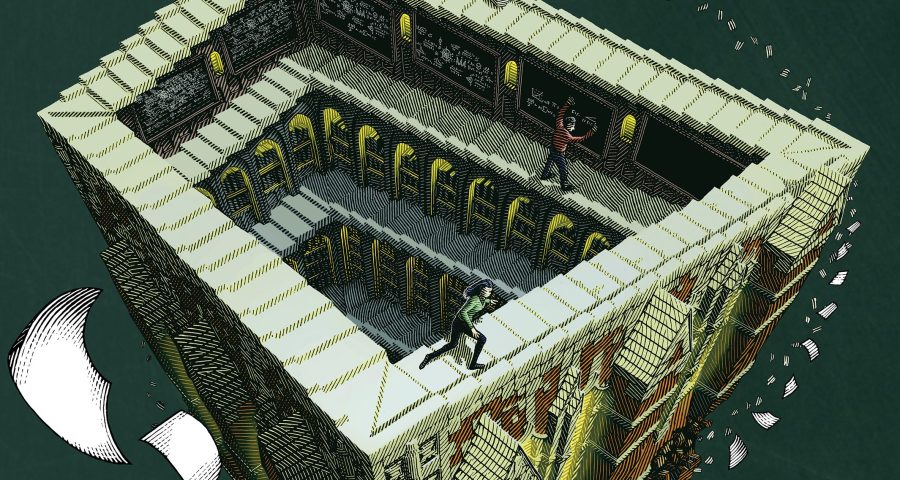
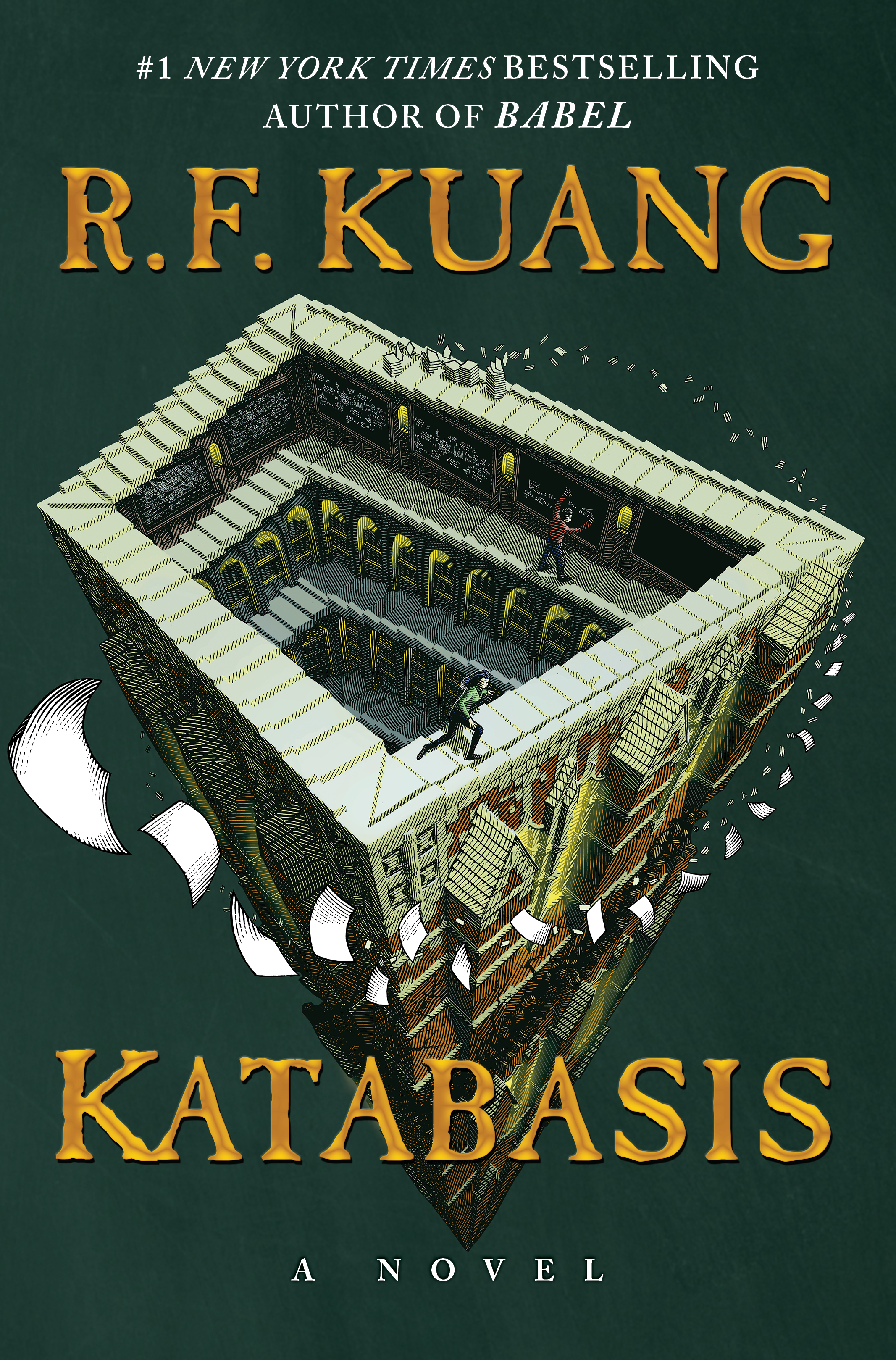
A very highly anticipated novel from the author that brought us Babel, Katabasis is pitched as a dark academia-esque novel where two Ph.D students venture into hell in order to save the soul of their advisor who died in a freak magic accident. Intriguing premise? Yes. Cover art? On point. So far it was two for two in getting me to pick it up, considering I am yet to read Babel (it was a little too slow for me at the time). I was hoping this was the book that would convert me into a fan and get me to pick up Babel again. Unfortunately, this is where we learn to not judge a book by its cover; exquisite as it may be.
The book revolves around Alice Law, a post graduate at Cambridge (as she reminds us of this fact quite a bit over the course of the book), who decides to venture into Hell in order to save the recently departed soul of her mentor, Professor Jacob Grimes. Why you may ask? Because in her mind, without his recommendation and influence, there would be no way in which she would be able to get a good job in the future. Umm, what?! She isn’t alone either. She is joined by her academic rival, Peter Murdoch, who also for reasons of his own, is planning on going to Hell to save the same professor.
At this point, I had so many questions foremost of which was, what is wrong with these people? But I decided to leave it be and see if there is a more sane reason to follow this path, considering these are academics after all. They’re post graduates at Cambridge, if I hadn’t mentioned already. It wasn’t long before I was scratching my head again when it was revealed that a trip to hell requires the person to give up half of their life span, and our protagonists couldn’t care less. To Alice, it is more important to live as one of the brightest minds than to deal with the inadequacies that old age would bring. Provided this sojourn of hers into Hell works out. Sigh.
Setting hopes for her character growth over the course of the book, I began to look forward to the portrayal of Hell and its daunting trials, as that seemed like it would be fun. What followed can only be called an annoying nightmare. Not the kind of nightmare that one can expect when travelling through the various regions of hell, but one where you’re stuck with two people who think they’re the smartest people alive and are beyond condescending and obtuse when it comes to agreeing to anything. The characters completely overshadowed the regions of Hell and it just felt underwhelming. Maybe the characters were written to be unlikeable in the beginning?
The concept of travelling to Hell isn’t new but the idea that Hell reshapes itself depending on the people made for a very interesting premise. This meant that Hell took the shape of familiar campuses and long winding corridors for the two academics. This book was pitched as a dark academia novel but outside of this academia hellscape, it strayed away from the typical dark academia tropes which made it a bit confusing why it was pitched as one in the first place. The different levels of Hell were adapted accordingly to suit the academic characters while also providing historical insight that guide our protagonists in traversing them.
The behaviour of two highly educated protagonists who are travelling through Hell is mind-boggling in their initial nonchalance to the situation they voluntarily placed themselves in. Relying on knowledge gained from historical records, we the readers, are treated to several explanations of philosophical conundrums, logical problems, mathematical concepts, and historical references, all of which could be read on wikipedia. The explanations kept breaking the flow of the story and were a bit longer than I felt was necessary.
Oh, by the way, there is magic in this world, or should I say magick? Ugh. There was very little explanation about how the magic(k) system works, other than you need chalk with which to draw pentagrams and that they rely on logic paradoxes. Again, it feels like an unnecessary decision that was made in order to justify the setting being Cambridge. In alI of this, the reasoning behind why chalk works for pentagrams was pretty neat. So that was a positive.
It’s only fairly late in the book that I realised this book is set in the 1980s which helped me rationalise some of the issues around academia that were mentioned in the book. Academia has never been easy but navigating it at the time would have been ‘hell’ compared to today. Everyone has their own stories from their time in academia but I think the portrayal of Alice is what really frustrated me the most. She is brash, condescending, hypocritical in her actions and unheeding of the consequences or the effect they may have on the people around her; especially when you’re in Hell! While some people may relate to her behaviour, and blind hero worship of her advisor, I could not rationalise how someone who spends the majority of the book harping on about how smart they are, decides that everything is okay if they make, and vehemently stick to, the assumption that their overbearing, rude, sexist, arrogant, egotistical professor was just ‘misunderstood’ and just wants the best for his best students. *Takes a deep breath*
I should also say that there is a love story here as well. It felt forced and, at times, utterly unnecessary. In my opinion if it was removed it may have made for a slightly more interesting read; but not by much. There was very little provided to make the love story have any weight outside of being stuck in hell together. Even the glimpses into the backstories of the characters were too erratic and in one instance, too little too late, to help endear us to these very flawed characters. I found myself shaking my head in annoyance for a majority of their iteractions all while holding out hope for a significant shift in character growth to maybe, just maybe, salvage something that could make this love angle make sense. I didn’t find it.
Yeah. If it wasn’t obvious, I didn’t like this book much. Honestly, a very interesting premise with a lot of potential (hence the second star in the review) but it’s just ruined by the very unlikable protagonist, and the absolutely banal journey through Hell. If you’re a fan of the author’s work, this may work for you but I honestly wouldn’t recommend it. Doesn’t seem like I’ll be picking up Babel anytime soon. Sigh.
Rating:
Links:
- Goodreads: Katabasis – R.F. Kuang
 Liminal Ramblings